Right to work checks: the UK employer guide for 2026
How to carry out, record and repeat a right to work check the way the Home Office expects — including share codes, eVisas, identity service providers and the extended scheme from 1 October 2026.
Last reviewed November 2026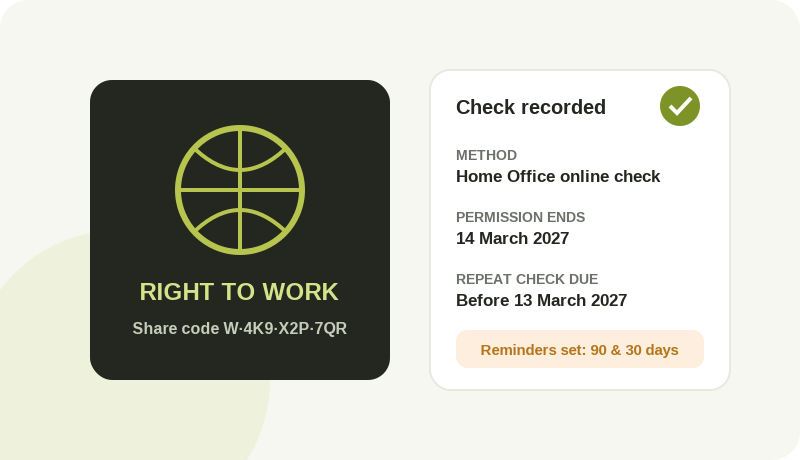
What a right to work check is
A right to work check is how a UK employer confirms that a person is allowed to work in the UK and to do the specific work being offered. You must do it before the person starts. Done correctly and recorded, the check gives you a statutory excuse: if it later turns out the person did not have the right to work, you are protected from a civil penalty.
Check everyone, not just people you think might be from overseas. Checking only some people because of their nationality, accent or appearance risks a discrimination claim. Since 1 October 2026 the duty also reaches workers, individual subcontractors and people engaged through online platforms — see what changed in October 2026.
The three ways to check
1. Home Office online check (share code)
Most people with immigration permission now hold an eVisa rather than a physical document, and for them the online check is mandatory. The person creates a right to work share code — it begins with "W" and lasts 90 days — and gives it to you. You enter the code and their date of birth into the Home Office employer service, check the photo matches the person and save the result. Looking at their own UKVI account screen is not enough.
2. Manual document check
Where the Home Office allows physical documents — for example a British or Irish passport — you check the original document in the person's presence, make sure it is genuine and belongs to them, and keep a clear copy. Expired biometric residence permits cannot be accepted.
3. Identity service provider (IDSP)
For valid British and Irish passports and Irish passport cards you can choose a certified digital verification service to check identity remotely. You are still responsible for the check, so choose a certified provider and keep the result.
Don't insist on one methodUnless the person holds an eVisa (where the online check is mandatory), you should not force a particular method. Offer the permitted alternatives.
How to do a check, step by step
- ObtainGet the share code and date of birth, or the original acceptable documents.
- CheckConfirm the photo and details match the person, the documents are genuine and in date, and any work restrictions (such as hours or job type) fit the role.
- Copy and dateSave the online result or a clear copy of each document, and record the date you made the check and who did it.
- Diary the follow-upIf permission is time-limited, set the date for a repeat check before it ends.
Repeat (follow-up) checks
Your statutory excuse only lasts as long as the person's permission. If someone has time-limited permission, you must repeat the check before it expires. Miss that date and you lose your protection, even if the person has applied to extend their stay. Not sure when your next checks fall due? The right to work penalty calculator works out a repeat-check date and shows the exposure if it is missed.
Record keeping
Keep the evidence securely for the length of the person's employment and for two years afterwards, then delete it. Make sure records are easy to retrieve: during a Home Office visit you may be asked to show the check for any member of staff. Sponsor licence holders have extra duties under Appendix D — read the sponsor licence compliance guide.
Penalties
Employing someone who does not have the right to work, without a statutory excuse, can lead to a civil penalty of up to £45,000 per worker for a first breach and up to £60,000 per worker for a repeat breach within three years. Reductions are available for reporting a suspected illegal worker and for active co-operation. Knowingly employing an illegal worker is a criminal offence, and a breach can also cost you your sponsor licence.
How VP HR helps
VP HR does not replace the Home Office check, but it makes sure every check is recorded, findable and repeated on time:
- Store the online result or document copies on each employee's profile, with the check date and who checked.
- Track visa, eVisa, passport and licence expiry dates, with automatic alerts before follow-up checks fall due.
- See every person with missing evidence on one Needs attention list.
- Show any check in seconds during a compliance visit.
See all features on the Home Office compliance software page.
This guide summarises the Home Office employer guidance in force in November 2026. It is not legal advice; check the current Employer's guide to right to work checks on GOV.UK before relying on it.
Right to work check FAQs
Who needs a right to work check?
Every person you employ needs a right to work check before they start, whatever their nationality. From 1 October 2026 the scheme was extended to workers, individual subcontractors and people engaged through online matching services, so many businesses now need to check people who are not their employees.
How long is a right to work share code valid?
A right to work share code begins with the letter W and is valid for 90 days. You enter it, with the person's date of birth, into the Home Office online service and check that the photo on the profile matches the person in front of you.
Can I still accept a biometric residence permit?
No. Physical biometric residence permits are no longer acceptable proof of right to work. People with an eVisa prove their status online with a share code, and for them the online check is mandatory.
Can I insist on a digital check for everyone?
No. Except where the person holds an eVisa and the online check is mandatory, you must not insist on one method. For example, a British citizen can show a valid passport for a manual check, or you can choose to use a certified identity service provider.
When do I need to repeat a right to work check?
If a person has time-limited permission to work, you must carry out a follow-up check before that permission ends to keep your statutory excuse. Checks for people with unlimited permission, such as British citizens or those with settled status, do not need repeating.
How long should I keep right to work records?
Keep a clear copy of the evidence and a dated record of the check for the whole time the person works for you and for two years after they leave, then delete it securely. Sponsor licence holders also have the Appendix D record-keeping duties.
What happens if I get a check wrong?
If you employ someone without the right to work and you have no statutory excuse, you can receive a civil penalty of up to £45,000 per worker for a first breach and up to £60,000 per worker for a repeat breach. Knowingly employing an illegal worker is also a criminal offence.
Keep reading
Never miss a repeat check again
VP HR tracks every right to work expiry and reminds you before your statutory excuse lapses.